📝 题目
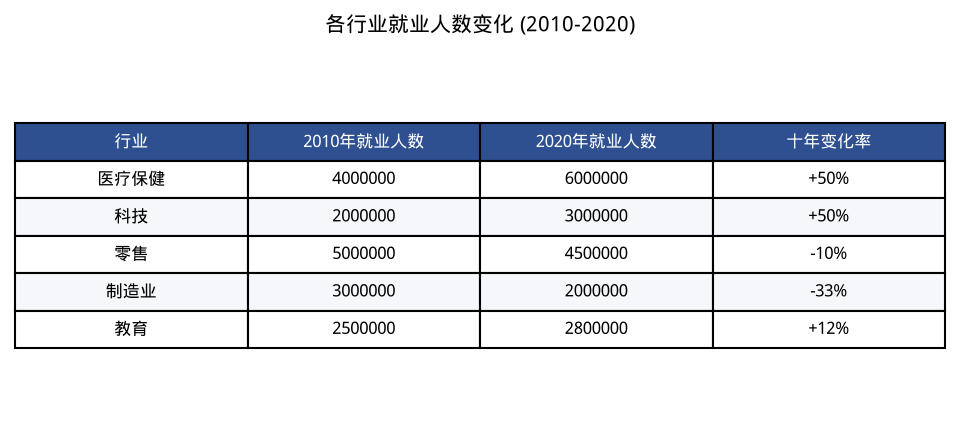
The table below shows the number of people employed in five industry sectors in 2010 and 2020, and the percentage change over the decade. Summarise the information by selecting and reporting the main features, and make comparisons where relevant.
📊 图表内容说明
表格展示五个行业2010/2020年就业人数及十年变化率:Healthcare 4M→6M(+50%)增幅最大;Technology 2M→3M(+50%);Retail 5M→4.5M(-10%);Manufacturing 3M→2M(-33%)降幅最大;Education 2.5M→2.8M(+12%)。
✍️ 满分范文
主体段 1
The table presents employment figures across five industry sectors in 2010 and 2020, along with the percentage change over the decade.
改写题目:number of people employed→employment figures, five industry sectors保留。
主体段 2
Overall, healthcare and technology experienced the most significant growth, while manufacturing suffered the sharpest decline. Healthcare employed the most people in both years, and technology, despite having the fewest workers initially, showed the joint-highest growth rate alongside healthcare.
分组概括:增长组(healthcare/technology) vs 下降组(manufacturing/retail)。指出healthcare始终最大、technology增幅并列最高——两个关键特征。
主体段 3
Healthcare had the largest workforce in both years, growing from 4 million to 6 million — a 50% increase. The technology sector matched this growth rate, rising from 2 million to 3 million, although its total workforce remained the smallest. Education saw a more modest increase of 12%, from 2.5 million to 2.8 million.
按增幅从大到小描述增长行业。用'matched this growth rate'避免重复50%,用'although'转折说明technology总量仍最小。
主体段 4
By contrast, employment in manufacturing fell sharply by 33%, dropping from 3 million to 2 million. Retail also experienced a decline, albeit a smaller one, falling by 10% from 5 million to 4.5 million. Notably, the combined growth in healthcare and technology (3 million new jobs) more than offset the total jobs lost in manufacturing and retail (1.5 million), suggesting an overall shift towards service and knowledge-based industries.
用By contrast转入下降行业。末句做出跨行业推论:增长行业新增岗位超过下降行业流失岗位——合理推断产业转型趋势。这是Band 9的分析深度。
📚 核心词汇
workforce (劳动力)
·
替换employees/workers
☆
joint-highest (并列最高)
·
精确比较
☆
albeit (尽管)
·
高级让步连词
☆
offset (抵消)
·
描述总量平衡
☆
sharp decline (急剧下降)
·
替换big decrease
☆
shift (转变)
·
描述结构性变化
☆
🏆 高分句型
experienced the most significant growth
→
用于描述增长最显著的行业,动词experience比increase更正式,强调趋势。可替换:saw the most notable rise / recorded the strongest growth。
☆
suffered the sharpest decline
→
用suffer强调下降的消极影响,比decrease更生动。可替换:underwent the biggest drop / witnessed the most severe fall。
☆
the joint-highest growth rate
→
意为“并列最高增长率”,joint-表示“共同的”,精准体现两个行业相等。可替换:the equal highest rate / shared the top growth rate。
☆
matched this growth rate
→
表示“与这一增长率持平”,避免重复用same,体现数据比较的简洁性。可替换:equaled this rate / mirrored this growth。
☆
albeit a smaller one
→
albeit意为“虽然”,后接名词短语,让步补充时使句子紧凑。可替换:although smaller / though with a smaller increase。
☆
more than offset the total jobs lost
→
more than offset表示“远超抵消”,强调净增长,常用于对比增减。可替换:outnumbered the losses / compensated for the declines。
☆
an overall shift towards service and knowledge-based industries
→
总结性概括,点明就业结构的总体变化,体现趋势判断。可替换:a broader move towards service and knowledge sectors。
☆
这篇范文已就绪,登录即可查看全文
满分范文 —— 英文原文 + 中文翻译 + 逐段解析
高分句型 / 核心词汇 —— 重点表达即学即用
免费注册,登录即看,无需付费
 沪公网安备31011002008124号